 Sanjay Chaudhary
Sourcing spices for a restaurant, retail brand, or food manufacturing line is never just a transaction — it’s a decision that shapes flavour, food safety, and customer trust. A single batch of adulterated turmeric or stale chilli powder can undo months of menu development in one shipment. Yet many buyers still pick a spice supplier on price alone, without asking the questions that actually predict reliability. Before you sign a purchase order, here are ten questions worth asking — whether you’re comparing a local vendor or a spices supplier in India for export.
Why the Right Spice Supplier Matters More Than You Think
Spices are an unusually high-risk category for quality inconsistency, because they’re cleaned, ground, and blended long before they reach you — unlike fresh produce, you can’t simply look at a jar of chilli powder and know what went into it. A dependable spice manufacturer protects you from contamination, inconsistent batches, and compliance issues that can hold up import clearance or a local food licence. For wholesalers, restaurants, and food brands, it also means predictable lead times and a product that tastes the same in batch fifty as it did in batch one.
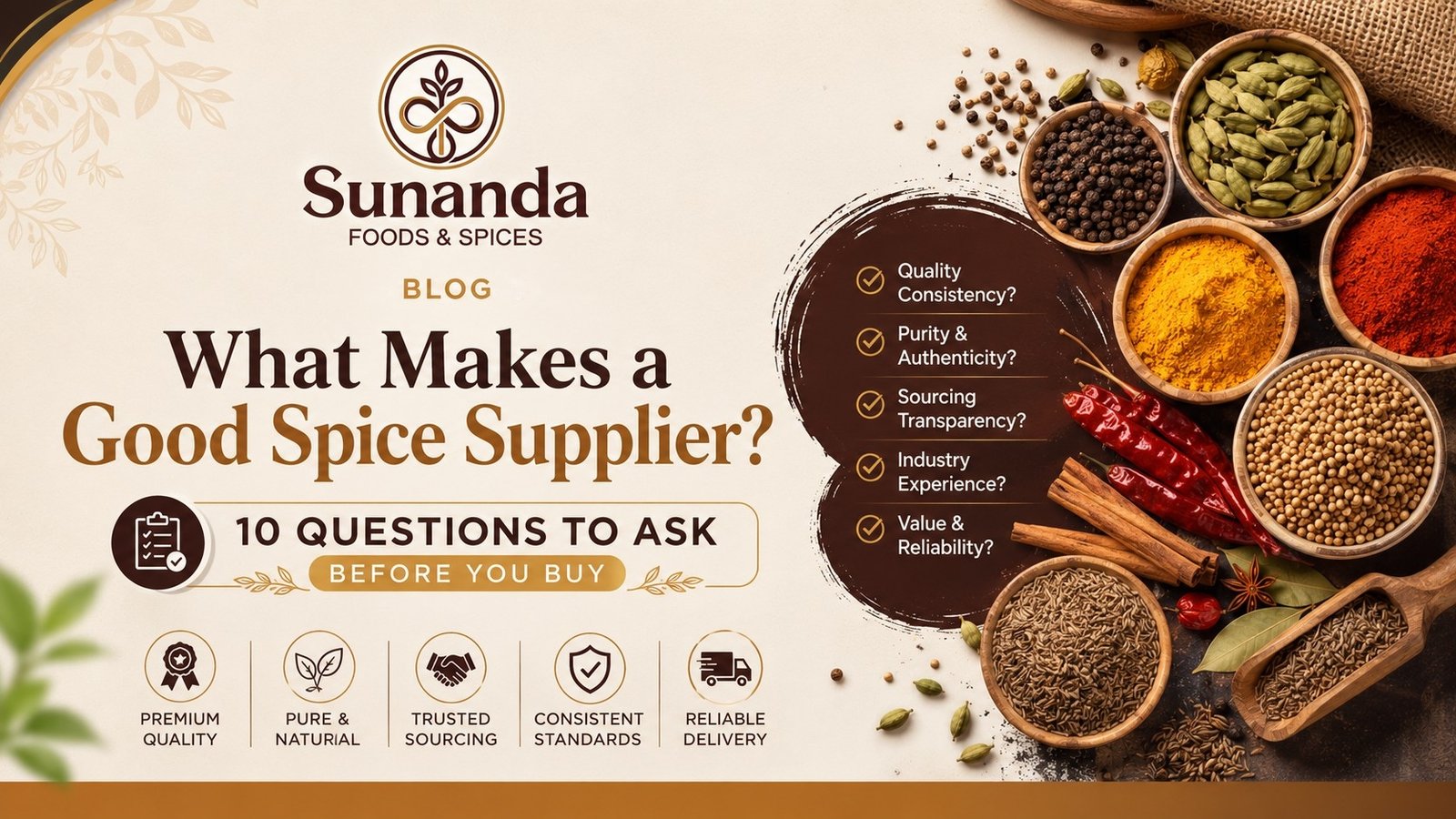
10 Questions to Ask Before Choosing a Spice Supplier
Use this checklist the next time you’re evaluating a spice manufacturer, wholesaler, or exporter.
1. Do They Hold Valid Food Safety Certifications?
Ask for proof of FSSAI registration at minimum, then look for ISO, APEDA, Halal, or FDA recognition depending on your market. Certifications don’t guarantee perfection, but they confirm the supplier operates under documented hygiene and quality systems rather than informal ones.
2. Where Do They Source Their Raw Spices?
A good supplier can tell you which regions or farms their turmeric, chilli, or cumin comes from. Direct relationships with growers usually mean tighter quality control and traceability than buying through unverified middlemen — which matters if you ever need to investigate a complaint.
3. What Does Their Cleaning and Processing Look Like?
Ask how raw spices are cleaned, sorted, and graded before grinding. Impurity removal, moisture control, and grading by size or colour all affect the final product’s purity. A supplier who can walk you through this process step by step is usually one who takes it seriously.
4. Can You Request Samples Before Committing?
Any supplier confident in their product should be willing to send samples ahead of a bulk order. Use that sample to judge aroma, colour, and texture against your own benchmarks — not just the numbers on a price sheet.
5. Do They Have Genuine Export Experience?
If you’re importing, ask about their track record with international shipments and compliance with destination-country regulations. Spices Board India and APEDA registration are good signals that a supplier regularly handles export paperwork correctly, reducing the risk of delays at customs.
6. What’s Their Minimum Order Quantity and Capacity?
Confirm that their MOQ and production capacity genuinely match your needs — both for a first order and for repeat demand as your business grows. A supplier who can’t scale with you becomes a bottleneck later, even if the first order goes smoothly.
7. Can They Customise Packaging or Private Label?
If you’re building your own brand, ask whether the supplier offers custom pack sizes and private labelling. This one capability often decides whether you can launch a retail line without arranging separate co-packing elsewhere.
8. How Do They Preserve Freshness and Aroma?
Ask about their grinding method specifically. Low-heat grinding protects the volatile oils responsible for a spice’s aroma, while high-heat processing can leave you with a duller, flatter product even if it still looks fine on the shelf.
9. Is Their Pricing Transparent?
A trustworthy supplier explains exactly what’s included in a quote — packaging, freight, taxes, and any minimum-order surcharges — instead of leaving you to discover hidden costs after the order is confirmed.
10. How Responsive Is Their Team?
Send a test inquiry and note how quickly and clearly they reply. Communication speed before the sale is usually a fair preview of how a supplier will handle questions, complaints, or delays after it.
How Sunanda Food & Spices Measures Up
At Sunanda Food & Spices, our process is built around these exact questions, because we’ve sat on the buyer’s side of this conversation too. Operating from Gandhinagar, Gujarat, we’re FSSAI, ISO, APEDA, Spices Board India, Halal, and FDA recognised, sourcing raw materials directly from trusted farms and processing through cleaning, sorting, low-heat grinding, and hygienic, airtight packaging. We supply bulk orders to food manufacturers, distributors, and restaurants, offer customised packaging, and export to international clients, typically replying within 24 hours. Browse our range of spices to see where we might fit your supply chain.
Final Thoughts
Choosing a spice supplier gets a lot easier once you stop comparing price lists and start comparing certifications, processes, and communication. The ten questions above won’t just help you avoid one bad batch — they’ll help you find a long-term partner who can grow alongside your business. To request samples, certifications, or a bulk quote, contact our team.